
Pyrometallurgy

Pyrometallurgy Process
Click to enlarge

Battery recycling is essential for resource conservation and environmental protection. Among various recycling techniques, pyrometallurgy stands out for its ability to treat complex and contaminated waste streams. Traditionally dominant in the recycling of LABs, pyrometallurgical methods are now being explored for Ni-MH and Li-ion batteries due to increasing volumes of end-of-life batteries and the high value of metals like cobalt, nickel, and lithium.

Process Steps

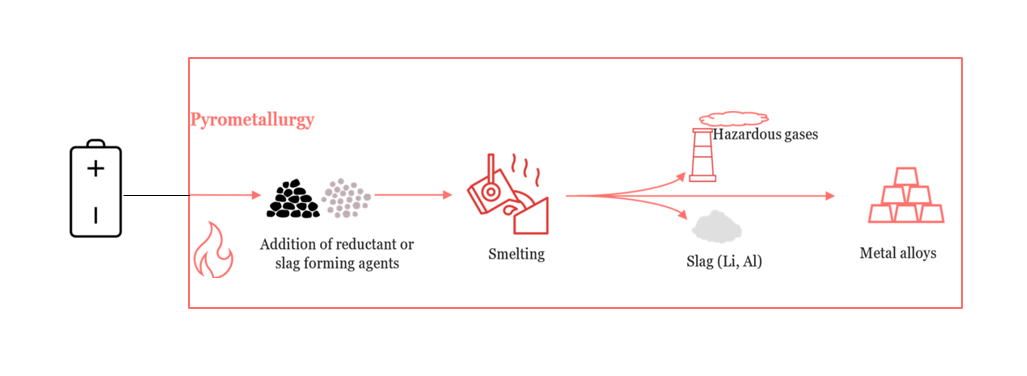
Pyrometallurgy involves the use of high temperatures (typically 1000–1600°C) to decompose battery materials, recover valuable metals, and separate impurities. The general process includes the following steps:

  1. Pre-treatment: are discharged to avoid short-circuiting and fire hazards. Components are dismantled manually or mechanically. Electrolytes are removed via neutralization or evaporation. For Li-ion and Ni-MH, thermal pre-treatment is often used to remove binders and organics.
  2. Smelting or Reduction: Processed battery materials are fed into a high-temperature furnace such as a blast furnace, rotary kiln, or electric arc furnace. Reductants like carbon or coke convert metal oxides to their elemental forms. Fluxes such as silica, soda ash, and lime are added to form slag and promote metal separation.
  3. Phase Separation: The furnace separates the molten content into distinct phases:
    • Metal Phase: Contains valuable metals (e.g., Pb, Ni, Co).
    • Slag Phase: Contains less recoverable materials like Li, Al, Mn, and REEs.
    • Gas Phase: Includes volatile organics and oxides (e.g., CO₂, SO₂).
  4. Refining:The recovered metal alloys undergo refining to improve purity. Lead alloys are desulfurized and demetallized. Ni-Co alloys may undergo hydrometallurgical post-treatment for separation.
  5. Gas Handling:Emissions are treated with filters, scrubbers, or baghouses to capture particulates and acid gases. Waste heat recovery systems are used to improve energy efficiency.

Applications

  • Lead-Acid Batteries (LABs): LAB recycling involves smelting lead compounds (PbSO₄, PbO, PbO₂) at ~1000–1200°C. Soda ash acts as a flux and reductant. Iron or coke is added to assist reduction. The process efficiently recovers lead with yields over 95%, but generates SO₂, necessitating flue gas desulfurization. Slag from LABs typically contains minimal reusable metal.
  • Nickel-Metal Hydride (Ni-MH) Batteries: Ni-MH batteries are shredded and subjected to controlled thermal decomposition to reduce complex hydrides and organics. Smelting recovers Ni and Co in alloy form, while REEs like La, Ce, and Nd migrate to the slag. Pyrometallurgical efficiency can exceed 80% for Ni and Co.
  • Lithium-Ion Batteries (Li-ion): Li-ion batteries are complex and contain valuable metals like Co, Ni, Mn, and less recoverable elements like Li and Al. High-temperature arc smelting focuses on Co and Ni recovery, forming metal-rich alloys. Lithium migrates to the slag, requiring subsequent hydrometallurgical leaching. Advanced processes, such as reductive atmosphere control and flux engineering, improve yield but are energy-intensive. Integration with slag leaching is often necessary to recover Li and Mn.

Environmental Aspects

  • Process Efficiency and Recovery Pyrometallurgy ensures high recovery rates for Pb, Ni, and Co (85–98%) but struggles with Li and REEs due to their affinity for slag. Reaction kinetics depend on furnace temperature, reductant reactivity, and residence time. Optimization of slag composition and furnace atmosphere is crucial for maximizing metal separation.
  • Environmental Impacts Environmental concerns include CO₂ and SO₂ emissions, toxic dioxins from organics, and heavy metal vapors. Gas scrubbing, activated carbon filters, and condensation systems are employed to mitigate emissions. Pyrometallurgical processes are energy-intensive; however, coupling with energy recovery (e.g., waste heat boilers) can reduce the net environmental footprint.
Hydrometallurgy

Hydrometallurgy Process
Click to enlarge

The rapid expansion of the battery industry, particularly in electric mobility and portable electronics, has created an urgent demand for efficient, sustainable recycling methods. Hydrometallurgy offers a promising solution due to its high selectivity, energy efficiency, and ability to recover a broad range of critical and strategic metals. In contrast to high-temperature pyrometallurgical routes, hydrometallurgy operates at moderate temperatures (typically < 100°C ) and enables the recovery of lithium, cobalt, nickel, manganese, and rare earth elements with minimal environmental impact.

Process Steps

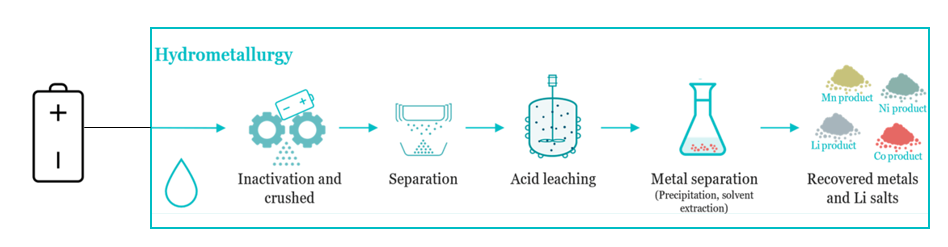
  1. Pre-treatment: Batteries are dismantled, and components are sorted. In Li-ion batteries, cathode materials are removed from aluminum foil via mechanical or thermal treatment. Ni-MH and LAB pastes are sometimes neutralized before leaching.
  2. Leaching: The metal-bearing material is treated with aqueous leaching agents (e.g., sulfuric acid, hydrochloric acid, nitric acid, or organic acids) to dissolve target metals. In some processes, oxidative agents like H₂O₂ or NaClO₃ are added to facilitate metal solubilization:
    • LiCoO₂ + 2H⁺ → Li⁺ + Co²⁺ + H₂O
    • PbSO₄ + HNO₃ → Pb(NO₃)₂ + H₂SO₄
  3. Solid-Liquid Separation: he leachate is separated from undissolved residues (e.g., graphite, plastics, silica) using filtration or centrifugation.
  4. Purification and Separation:
    • Solvent extraction isolates metals based on their differing affinities for organic solvents.
    • Ion exchange and selective precipitation are used to remove impurities or concentrate metals.
    • Cementation (metal replacement) may also be used for selective recovery.
  5. Recovery:
    • Electrowinning is applied to recover high-purity metals like cobalt and nickel.
    • Crystallization or precipitation recovers lithium as lithium carbonate or phosphate.
  6. Effluent Treatment: Spent solutions are treated to neutralize acidity and remove residual metal ions before disposal or recycling.

Applications

  • Lead-Acid Batteries (LABs): Hydrometallurgical recycling of LABs focuses on converting lead sulfate (PbSO₄) in the paste into lead oxide or lead carbonate via chemical leaching.
  • Nickel-Metal Hydride (Ni-MH) Batteries: Ni-MH batteries contain nickel, cobalt, and rare earths. Hydrometallurgy offers high selectivity for recovering these metals. Leaching is often done with sulfuric or hydrochloric acid in the presence of oxidants.
  • Lithium-Ion Batteries (Li-ion): Hydrometallurgy is most widely applied in Li-ion battery recycling. Leaching systems vary based on cathode chemistry:
    • Acidic systems (H₂SO₄ + H₂O₂) for NMC and LCO materials.
    • Organic systems (citric acid, oxalic acid) for more environmentally friendly operations.
    • Deep eutectic solvents (DESs) are also under development.

Environmental Aspects

  • electivity and Efficiency:Hydrometallurgy allows precise recovery of target metals at high purity (>98%) and lower energy input. However, the process generates liquid effluents containing dissolved organics, acid residues, and impurities, requiring effective wastewater treatment.
  • Environmental Impact: Compared to pyrometallurgy, hydrometallurgical processes have a lower carbon footprint and no hazardous air emissions. The challenges lie in the consumption of chemicals, effluent management, and occasional generation of complex secondary wastes.
  • Economic Viability:Though more selective, hydrometallurgy may require complex multi-step circuits and higher reagent costs. However, when integrated with mechanical pre-treatment and followed by circular reuse (e.g., regenerated cathode materials), the cost-performance ratio improves significantly.

Mechanical Pre-Treatment Process

Mechanical Pre-Treatment Process
Click to enlarge

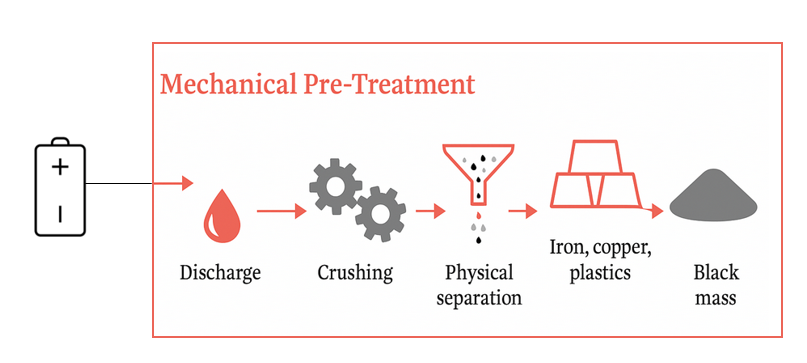
As global battery consumption increases, efficient recycling processes are essential for recovering valuable and critical materials. Mechanical pre-treatment provides the first stage in battery recycling, enabling safe handling, separation of components, and concentration of active materials for further processing. It reduces the load on chemical and thermal units, lowers environmental impact, and improves resource recovery rates.

Process Steps

  1. Discharging: Batteries are fully discharged to prevent fire or explosion hazards.
  2. Dismantling and Crushing: Manual or automated dismantling removes external casings and connectors. Shredders, hammer mills, or cutting machines reduce battery cells into smaller fragments.
  3. Solid-Liquid Separation: he leachate is separated from undissolved residues (e.g., graphite, plastics, silica) using filtration or centrifugation.
  4. Separation:
    • Magnetic separation removes ferrous components (steel, nickel).
    • Air classification and cyclone separation remove lighter plastics and fine particles.
    • Sieving and density-based separation (e.g., water or fluidized beds) separate current collectors (Al, Cu) from active material powders.
  5. Fine Material Collection:Cathode/anode powders containing Co, Ni, Mn, Li, or REEs are collected for subsequent hydrometallurgical or thermal treatment.

Applications

  • Lead-Acid Batteries (LABs): are commonly opened using mechanical saws and crushers. Lead grids and paste are separated from plastic cases. Paste is then washed, dried, and sometimes pelletized. Polypropylene is recovered and reused. Automated systems improve throughput and safety.
  • Nickel-Metal Hydride (Ni-MH) Batteries: Ni-MH batteries are mechanically opened and crushed. Magnetic separation isolates nickel and steel. Air classification and sieving concentrate hydride alloys (LaNi₅-type) and active rare earth elements. Proper mechanical sorting improves REE recovery in downstream steps.
  • Lithium-Ion Batteries (Li-ion): Li-ion cells are shredded under inert or cryogenic conditions to avoid fire. Fine black mass containing cathode materials (LiCoO₂, NMC, LFP) is separated from aluminum and copper foils. Studies show mechanical pre-treatment can recover >90% of metallic foil and active material prior to chemical extraction.

Environmental Aspects

  • Mechanical pre-treatment significantly reduces chemical reagent demand and leachate volumes.
  • It facilitates safer handling of hazardous electrolytes and reactive components.
  • Energy consumption is lower than thermal processes but can vary with shredding and separation technologies.

Integration with Chemical Processes

Mechanical methods act as front-end units for both hydrometallurgy and pyrometallurgy. Proper particle sizing and separation enhance leaching kinetics, reduce slag volumes, and increase overall recovery yields.

Combined Methods

Combined Methods
Click to enlarge

Standalone battery recycling methods—whether pyrometallurgical or hydrometallurgical—offer advantages and limitations based on battery chemistry, material value, and scale. While pyrometallurgy efficiently handles mixed chemistries and offers process simplicity, it has low lithium recovery and higher emissions. Hydrometallurgy provides superior selectivity and material purity but requires clean, pre-sorted input. Mechanical pre-treatment alone cannot achieve material recovery but plays a vital role in reducing complexity and enhancing process efficiency.

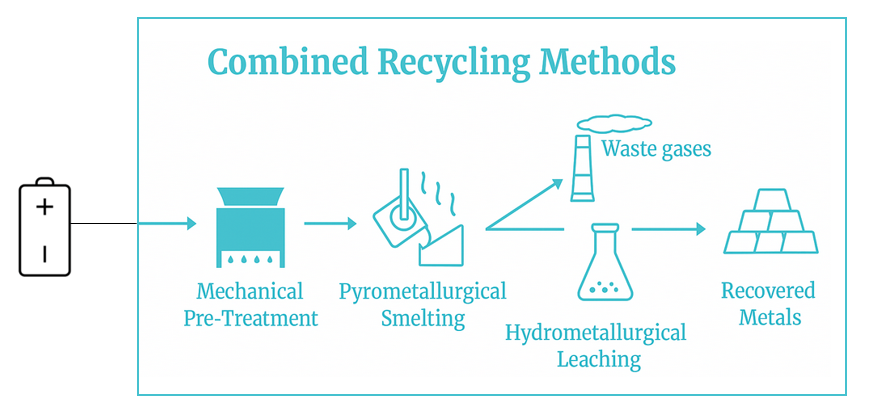
To overcome the limitations of individual technologies, combined methods have been developed. These hybrid systems leverage the robustness of thermal treatment, the precision of aqueous chemistry, and the selectivity of mechanical fractionation, creating closed-loop or semi-closed-loop processes with significantly higher yield and lower environmental impact.

Process Steps

  1. Mechanical Pre-Treatment: Shredding, magnetic separation, and classification remove casings and isolate black mass.
  2. Pyrometallurgical Treatment: Organic matter and plastics are thermally decomposed; metal alloys are collected, and slag is produced.
  3. Hydrometallurgical Leaching: Black mass or slag is subjected to acid leaching (e.g., H₂SO₄ + H₂O₂), followed by separation of Co, Ni, Mn, and Li using solvent extraction or precipitation.
  4. Refinement:Further purification of recovered metals or cathode precursor synthesis.

Applications

  • Lead-Acid Batteries (LABs): While LABs are widely recycled via pyrometallurgy, hybrid methods are emerging to improve lead purity and reduce SO₂ emissions. Mechanical separation isolates lead paste, which is then chemically treated using alkali or acid leaching. Some methods directly convert PbSO₄ to PbO using soda ash smelting followed by hydrometallurgical refinement.
  • Nickel-Metal Hydride (Ni-MH) Batteries: After mechanical separation of Ni-containing steel, the rare-earth-rich black mass is leached using acidic or alkaline hydrometallurgical systems. When needed, thermal pre-treatment (roasting) enhances leaching kinetics and reduces REE hydroxide passivation. Solvent extraction isolates Ce, La, Nd, and Pr, alongside Ni and Co.
  • Lithium-Ion Batteries (Li-ion): Combined methods are especially effective for Li-ion chemistries like NMC and NCA. Pyrometallurgy recovers Co, Ni, and Cu as an alloy, but Li remains in slag. Hydrometallurgical treatment of the slag (or black mass) then extracts Li as lithium carbonate or lithium phosphate

Environmental Aspects

  • Efficiency: Hybrid systems boost total recovery rates (often >95% for valuable metals) and reduce chemical reagent consumption by narrowing feed compositions.
  • Selectivity: Mechanical pre-treatment isolates metallics and active powders; hydrometallurgy then recovers pure salts or cathode precursors.
  • Emission Control:Hazardous gas generation during pyrometallurgy is minimized by using it only when necessary.
  • Energy Optimization:Direct leaching after mechanical steps reduces the need for full thermal treatment, saving energy.

Limitations and Challenges

  • Limitations and Challenges
  • Requires careful process control and feedstock consistency.
  • Slag from pyrometallurgy may still require landfilling or additional treatment.
  • Pre-sorting and battery chemistry identification remain barriers for automation.

Electrometallurgy Process

electrometallurgy
Click to enlarge

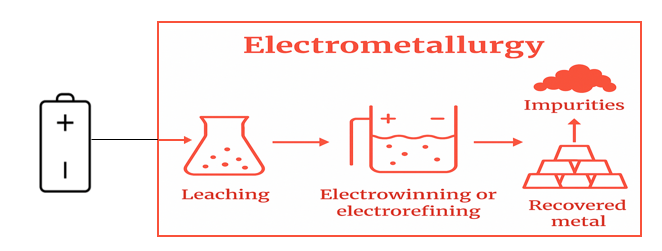
Electrometallurgical processes use electricity to drive oxidation-reduction reactions that selectively deposit metals onto electrodes. The most common methods—electrowinning (metal deposition from leach solutions) and electrorefining (purification of impure metals)—are integral in primary and secondary metallurgy. In battery recycling, they are typically applied after leaching in hydrometallurgical flowsheets to extract high-purity cobalt, nickel, zinc, and lead. This technique supports cleaner production cycles, reduces chemical waste, and enhances the circular economy for critical materials.

Electrometallurgical Techniques

  1. Electrowinning

    In electrowinning, metal ions in a leach solution are reduced at the cathode, forming solid metal, while a complementary oxidation reaction occurs at the anode. The process depends on:

    • Electrolyte composition (e.g., sulfate or chloride-based)
    • pH and temperature
    • Current density and electrode materials
  2. Electrorefining

    Electrorefining involves the dissolution of an impure metal anode and its redeposition as pure metal on the cathode. This method is common in lead recycling and copper purification. Impurities either remain in the electrolyte or form anode slimes.

Applications

  • Lead-Acid Batteries (LABs): Lead recovered from mechanical or smelting stages can be purified through electrorefining to produce battery-grade lead with low antimony, tin, and arsenic levels.
  • Nickel-Metal Hydride (Ni-MH) Batteries: After leaching, Ni²⁺ can be recovered using electrowinning from ammonia or sulfate electrolytes. Cobalt and rare earths may also be separated electrochemically depending on potential windows.
  • Lithium-Ion Batteries (Li-ion): Nickel and cobalt salts from Li-ion black mass leachate can be selectively recovered using pulse electrowinning techniques. Electrochemical recovery of lithium is rare but possible using modified membranes or hybrid electrochemical-precipitation systems.

Environmental Aspects

  • High Selectivity and Purity: Enables recovery of battery-grade metals without extensive chemical purification.
  • Mild Conditions:Lower energy requirements compared to pyrometallurgy; avoids combustion emissions.
  • Modular Design:Can be integrated into small or decentralized recycling units.
  • Reduced Reagent Use: Lower chemical consumption and waste generation.

Challenges and Considerations

  • Electrolyte Management: careful monitoring of metal concentration and conductivity.
  • Fouling: residues or impurities can reduce electrode life.
  • Costs: cells require controlled infrastructure and monitoring.
  • Universally Applicable: earths and lithium are challenging to recover electrochemically without complex pre-treatment.